How Artificial Intelligence Is Changing the Way Breaking News Is Reported

When major events unfold, every second counts. In modern newsrooms, the traditional hustle to cover live events has been augmented by digital speed, with algorithms processing vast streams of data in milliseconds. The integration of Artificial Intelligence in Breaking News Reporting has fundamentally altered how newsrooms detect, analyze, and distribute stories, shifting the media landscape toward unprecedented operational velocity.
From monitoring global satellite feeds to flagging subtle shifts on social platforms, AI technologies are reshaping the news cycle—not by replacing the human element, but by transforming the infrastructure behind live coverage.
AI-Powered News Monitoring and Real-Time Gathering
Modern breaking news rarely originates from a single incoming phone call or press release. Instead, it emerges across thousands of digital channels simultaneously. AI-powered news monitoring tools continuously scan web traffic, emergency radio frequencies, weather tracking networks, and social channels to detect early signals of major developments.
Instead of requiring human eyes on every screen, intelligent gathering tools analyze anomalies. A sudden spike in location-tagged images, an unusual concentration of flight diversions, or a rapid surge in specific search terms can instantly trigger internal alerts. By filtering out background noise, these algorithms direct editorial focus toward emerging events long before they dominate public attention.
Automated Alerts and Trend Detection
Machine learning models excel at identifying pattern deviations across massive data sets. In newsrooms, dynamic data monitoring allows reporters to spot developing situations early:
-
Geospatial Tracking: Satellite data and GPS feeds alert newsrooms to industrial fires, natural disasters, or military movements in near real time.
-
Financial and Economic Anomaly Detection: Algorithms scan regulatory filings and stock market fluctuations to flag unscheduled corporate announcements or sudden market shifts.
-
Predictive Social Listening: Natural language processing (NLP) models cluster user posts during crises to map affected zones and assess immediate needs.
Streamlining Editorial Workflows: Transcription to Fact-Checking
Once a breaking story is identified, speed depends entirely on workflow efficiency. Artificial intelligence has significantly reduced administrative friction, allowing journalists to dedicate more time to active investigation.
Audio Transcription and Multilingual Translation
During live press briefings, international summits, or field interviews, speech-to-text algorithms transcribe live audio into searchable text instantly. Automated translation tools instantly bridge language barriers, giving international desks immediate access to localized eyewitness accounts and official statements worldwide.
Accelerated Data Analysis and Content Generation
When breaking news involves dense data—such as economic indicators, election results, or public health updates—AI models process raw numbers into structured overviews within seconds. Automated draft generators can construct initial factual templates, freeing journalists to focus on qualitative analysis, interviews, and investigative depth.
Navigating Risks: Misinformation, Deepfakes, and Algorithmic Bias
While AI enhances coverage speed, it introduces critical vulnerabilities. The same tools that accelerate reporting can be weaponized or generate errors, creating severe risks for news organizations where accuracy is paramount.
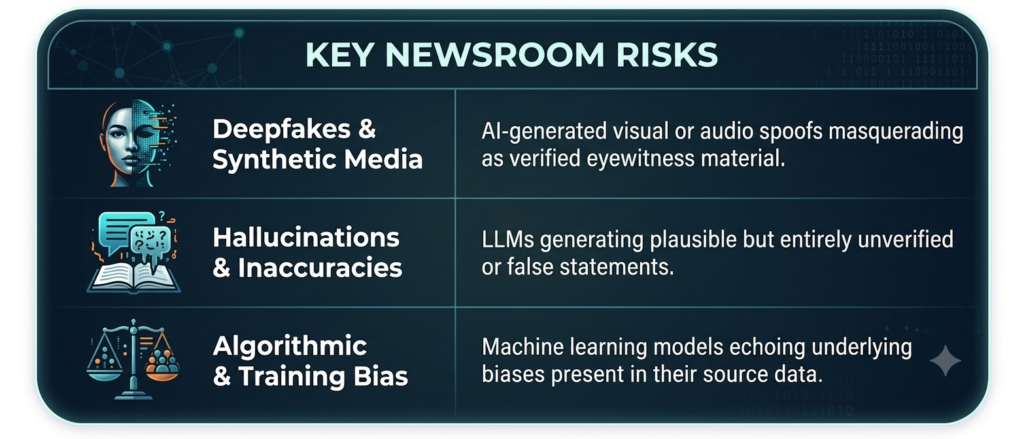
Fact-checking algorithms help verify metadata, source origins, and image manipulation, yet malicious actors continually adapt. Without rigorous verification protocols, automated systems risk amplifying synthetic content or misinterpreting context during live coverage.
Why Human Expertise Remains Unreplaceable
Despite significant technological advancements, artificial intelligence lacks fundamental human capabilities: empathy, contextual awareness, ethical judgment, and critical reasoning.
A computer program can identify a sudden surge in emergency tweets, but it cannot assess the emotional nuance of an interview, question official narratives with healthy skepticism, or evaluate the ethical implications of publishing sensitive imagery. Editors and reporters remain the essential gatekeepers who ensure news coverage adheres to journalistic standards, maintains accountability, and preserves public trust.
The Future of Artificial Intelligence in Breaking News Reporting
The dynamic between automated systems and editorial teams will continue to evolve. Future newsroom workflows will likely integrate hyper-localized verification models, automated metadata tags for deepfake identification, and predictive newsroom resource allocation.
Ultimately, technological tools serve to enhance—not dictate—journalistic inquiry. The primary objective remains unchanged: delivering accurate, timely, and contextually rich information to the public. As newsrooms continue adopting AI technologies, maintaining a rigorous human-in-the-loop framework will decide which organizations maintain credibility in an increasingly automated world.