SpaceX Stock Falls 23% From Peak — What It Means for IPO Investors
Investors who purchased SpaceX shares on the open market after its record-breaking IPO have now seen virtually all of their early profits vanish in just over a week.
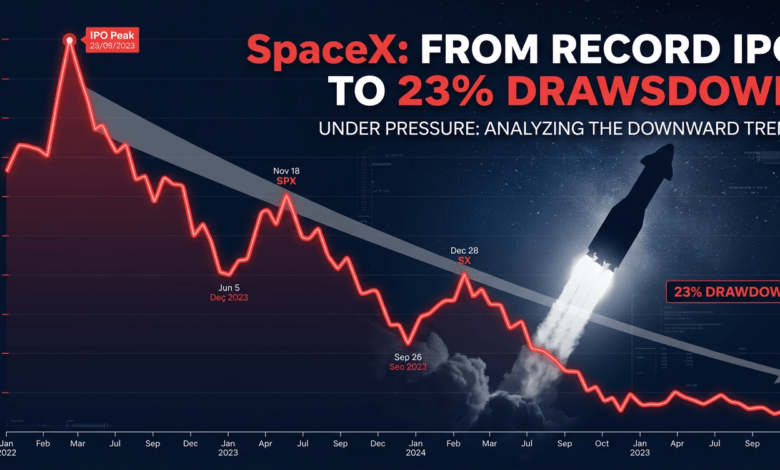
Elon Musk’s SpaceX had the stock market buzzing less than two weeks ago when it staged the largest initial public offering in history. Today, that excitement has given way to anxiety — shares of the aerospace and technology company tumbled 16% on Monday alone, closing at $154.60, just below the $160.90 opening price from its June 12 Nasdaq debut. It marked a third consecutive session of losses for the newly public giant.
At its June 16 peak of $201.80, SpaceX stock had dazzled early buyers with eye-catching returns. But by Monday’s close, those gains had all but disappeared, leaving open-market investors with little to show for their enthusiasm. The stock now sits roughly 23% below that high-water mark — a dramatic reversal in a remarkably short window.
Closing price
$154.60
Drop from peak
−23%
Market cap
~$2T
IPO raised
$85B+
The IPO itself was a triumph — for insiders
While retail investors are licking their wounds, SpaceX and its pre-IPO shareholders walked away with a historic windfall. The company raised over $85 billion through the offering — a figure that dwarfs any previous IPO in market history. Despite Monday’s sell-off, SpaceX’s market capitalisation remains near $2 trillion, placing it ahead of retail titan Walmart and social media behemoth Meta in terms of sheer size.
That cushion means the company’s long-term ambitions remain well-funded, even as short-term sentiment sours.
A bond deal raises fresh concerns
A key trigger for Monday’s sharp decline was a Bloomberg News report revealing that SpaceX was in discussions to raise at least $20 billion through a bond issuance. For investors already jittery about the capital-intensive nature of the company’s AI and space infrastructure plans, the news landed poorly.
“Investors are wary of the substantial cash required to fund technological ambitions.” — Jose Torres, Senior Economist, Interactive Brokers
Bond-funded expansion in a rising interest rate environment adds debt-service pressure that can weigh heavily on even the most promising companies — and SpaceX is no exception.
Broader market pain compounds the sell-off
SpaceX’s slide didn’t happen in a vacuum. Monday was a rough day across Wall Street. Google’s parent company Alphabet suffered its steepest single-day loss in more than a year, while the S&P 500 closed down 0.43% and the tech-heavy Nasdaq shed 1.3%.
Consumer-facing names weren’t spared either — Amazon, Netflix, Chipotle, McDonald’s, and Home Depot all posted notable declines. Meanwhile, oil prices dipped to their lowest levels since March as diplomatic progress in U.S.-Iran nuclear talks eased supply concerns.
Underlying the broader tech pullback is a persistent worry: that near-term inflation could raise borrowing costs, increasing the financial burden on mega-cap companies that have taken on significant debt to bankroll their AI infrastructure buildouts — a category SpaceX now firmly belongs to.
What comes next?
For retail investors who bought in post-IPO, the short-term picture is sobering. But SpaceX remains a company with enormous long-term ambitions — from satellite internet via Starlink to Mars colonisation — and its market cap still reflects substantial investor confidence in those goals.
Whether the stock finds a floor at current levels or continues to slide will likely depend on how the bond offering is received and how the broader tech sector weathers ongoing macro pressures. For now, patience may be the only asset retail investors have left.